

A Learning Curve
Some pieces don’t always work out and this is a collection of them so far, which I’ve used as a learning lesson going forward. Sometimes it depends on the structural integrity of the form, the glaze choice or could rely on the kiln gods… either way, I’m grateful for these pieces as I’ve learnt something new with them every time.
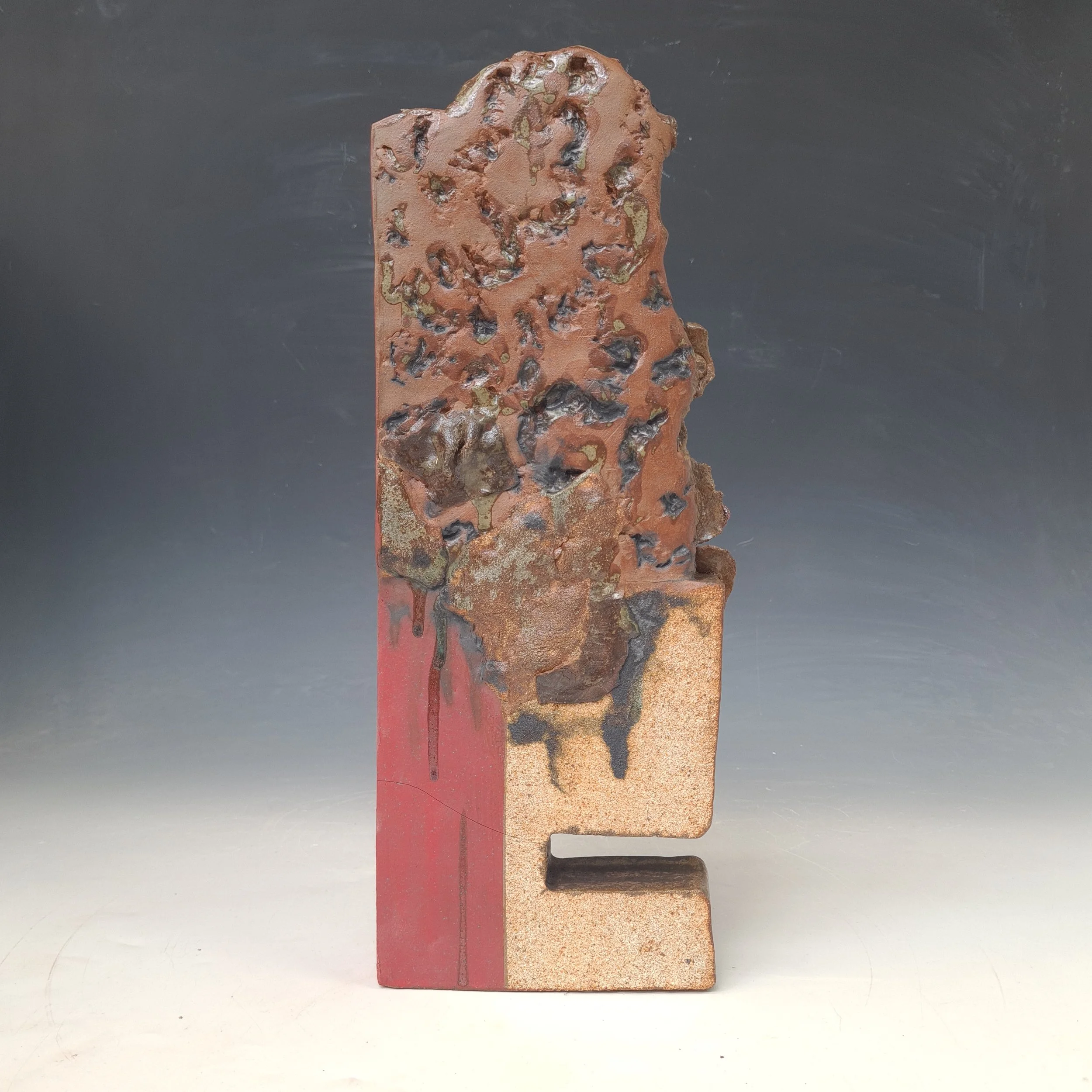
Cracked, Poor Form & Failed Glaze- June 2026- Reduction
This piece was made from grey stoneware clay and I used-
On the top- Copper Carb & Copper Oxide Wash with Transparent glaze. On the interior I used Test Tile 23 (Base Glaze C, Manganese 2% and Rutile 5%)
Below- Red Underglaze and Test Tile 23 again on inside and grogged surface on outside.
This piece survived the bisque firing with no cracks, but then in reduction, it cracked. The transparent glaze also burnt away in the firing, leaving a burnt clay colour and little amounts of oxide. The form also warped and, really, I wasn’t too thrilled with the form originally. I was using a sketch as a direct reference, which removed the process of intuition when making.
The red underglaze was the first time I used colour this bold, and in some ways, it works. I also liked the grogged surface. However, I was still (and still am) working on the relationship between the man-made and organic influences and I think this contrast was just too sharp and obvious.
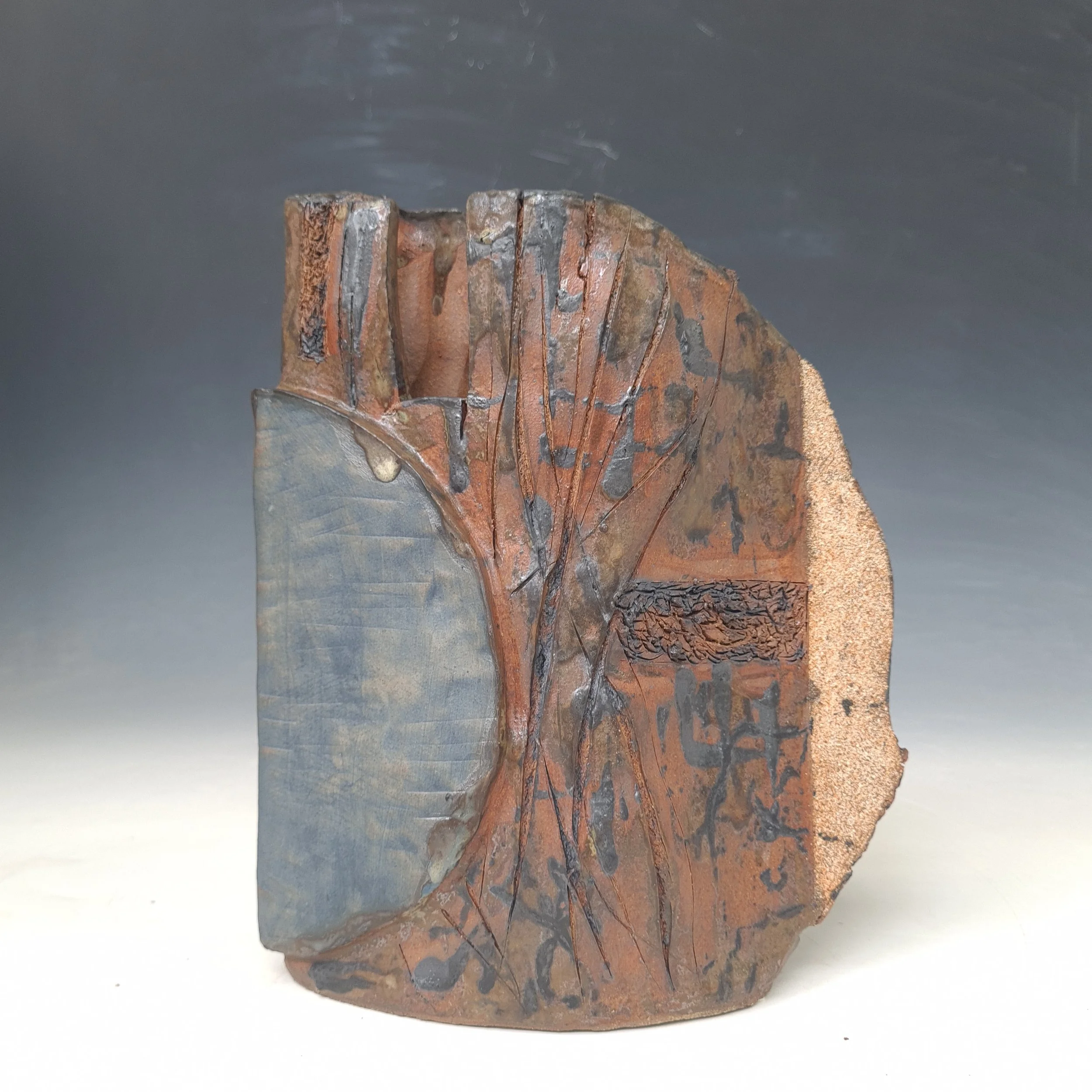
Poor Glaze Choice- May 2026- Reduction
Here I also used grey stoneware clay and I also used-
Black Engobe applied with a stick
Test Tile 21 applied in areas (Base Glaze C, Vanadium Pentoxide 8%)
Transparent glaze in areas
Copper Carb and Copper Oxide wash in areas
Blue slip applied to semi-circle
Here the glaze completely failed and just evaporated in the reduction kiln, again leaving that burnt clay colour. All that remained was the black engobe, which does not compliment the iron rich colour. The Blue slip also dramatically faded.
Here I learnt I really do need to apply glaze with multiple layers and question if my piece actually suits a reduction firing or not- I feel like the colours would of been more successful if I put it in an oxidation firing.
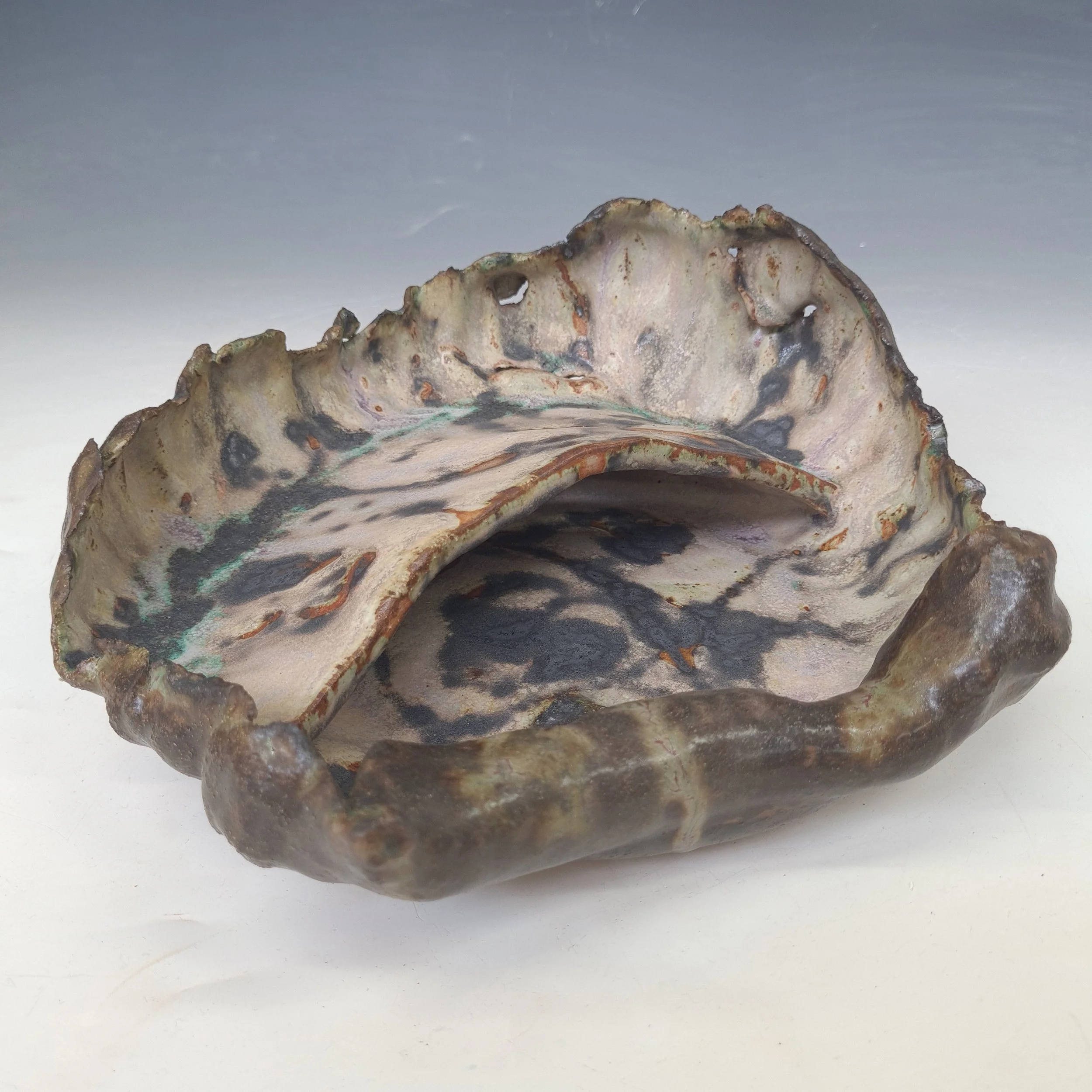
Oxide applied too heavily- June 2026- Reduction
This was very much an experimental piece- here I used a plaster former for the first time, in a bowl shape. I was able to pinch up the sides and apply an interior piece across. I used the grey stoneware clay for this.
I also used just base glaze C on it’s own on the interior then waited for it to dry. Once dry, I carved into it and applied copper carb oxide into the carvings. In this scenario, I applied too much oxide and it bled out and create harsh black marks. In some areas there’s some interesting results, like where it’s gone blue and crystalised. I also applied a very thick layer of white slip for the bisque firing so that may have enhance the results of the oxide.
On the exterior, I applied Test Tile 22 (Base Glaze C with Copper oxide 1.5% and Vanadium Pentoxide at 3%) and that came out as expected actually. I wanted a subtle inside with fine line lines and carvings and if successful, it could have been a great contrast.
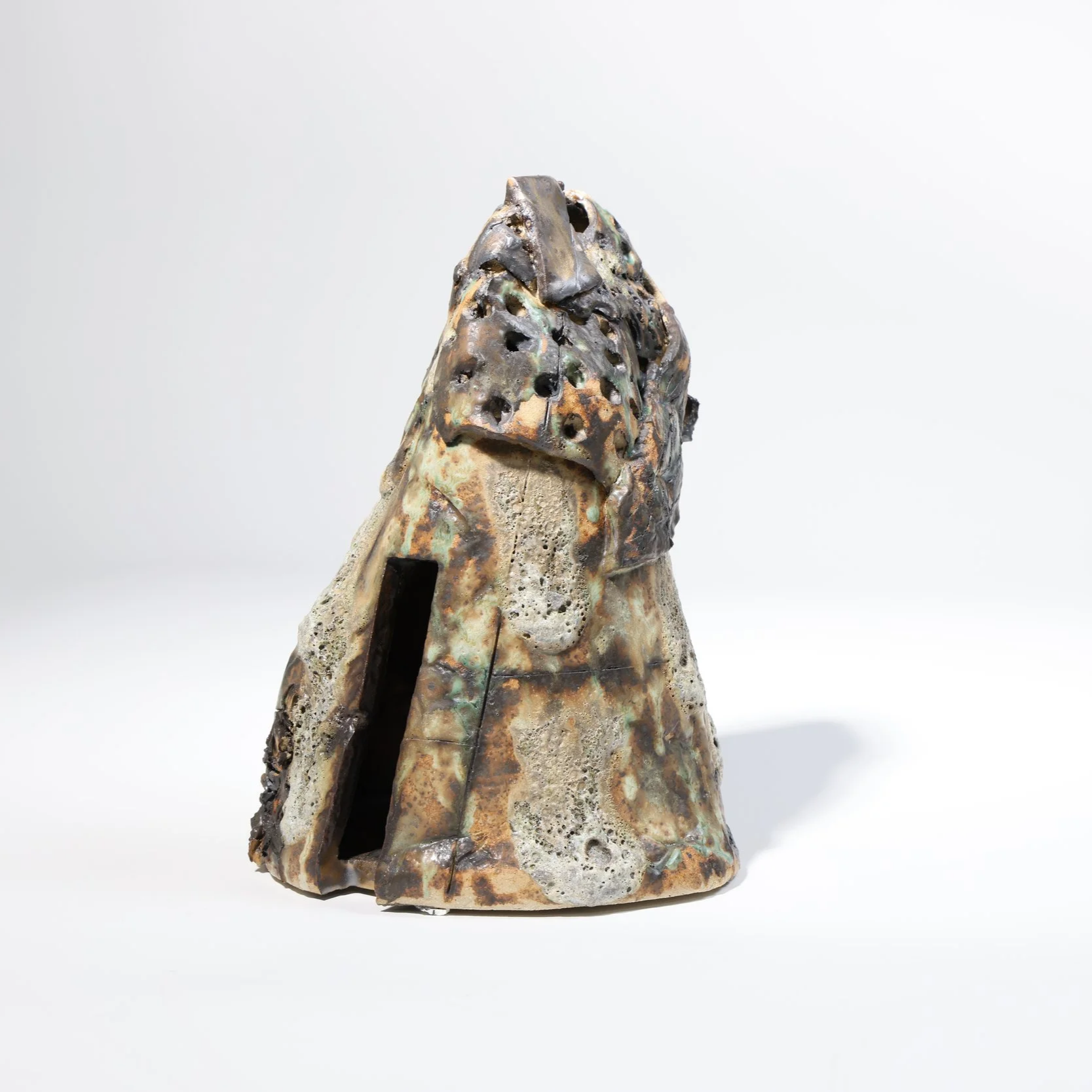
Strange Form- June 2026- Oxidation
Although I don’t dislike this piece, I feel like the form is not operating in the way I initially wanted it too.
After reading ‘Sculptural Vessels Across the Great Divide’ in Ceramic Reader on Pg 73, it made me consider the purpose of the traditional ceramic vessel form and inherently, I wanted to make something against this idea of a traditional vessel.
I begam with a slab with an open top and added a base- a vessel. However, I then decided I’d like to conceal the vessel form with slabs made of holes, so there’s still exposure to the inside, just not functional. I then cut a hole in the side and pierced three holes in the side also. Is this still a vessel? Potentially not, as it can’t contain anything. However, it was simply a piece that reflected my ongoing thoughts around this topic as it had been brought up in tutorials also.
Overall though, the form turned out rather wonky and not so visually balanced. The base disrupts from the original shape of the slab, perhaps it’s too big for the top of the form.
On the other hand, the glaze turned out exactly as I had imagined, so therefore this is why I don’t entirely dislike this piece.
I used-
Manganese Oxide and Copper Carb in the cracks
A bronze glaze I made last semester on the interior and holey slab pieces on the top
Sponged on Vanadium Pentoxide
A volcanic glaze I also made last semester