

The Ceramics Reader
April-August 2026 Semester
I found two extracts within The Ceramic Reader to be extremely helpful this semester (April-August 2026) when trying develop a wider context around my work. I’ve had this book on loan for probably close to 6 months and it’s a great resource to have handy when thinking about the field of ceramics and how my works situates within that. These two extracts mirror my thoughts when considering my position in the ceramics field and I find they highlights some of the key areas I’m exploring in my practice.
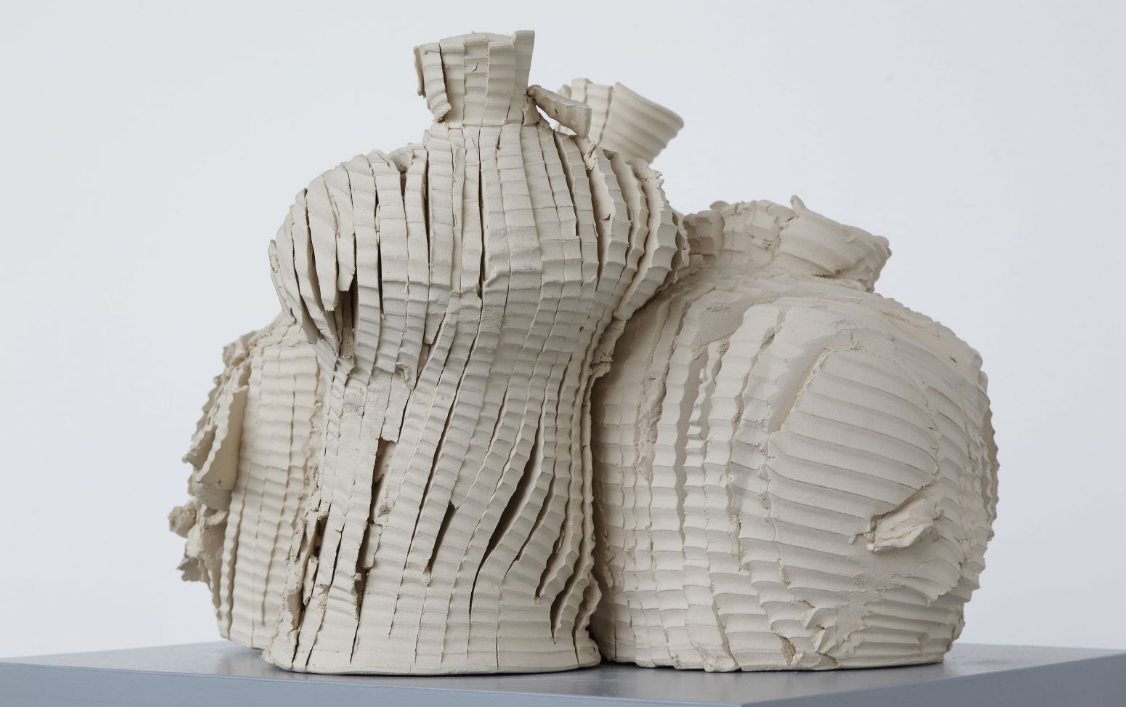
Tony Cragg
‘Laibe’ (1991) or as stated on Cragg’s website ‘Laib’ (1990)
Exhibited at Tate Liverpool in “A secret history of clay: From Gauguin to Gormley”
“Using the vessel form as an iconic starting point to explore sculptural ideas”
“Used the vessel form…to engage the viewers in ideas about ways in which humans relate to their environment…the coming together of clay and the vessel creates tensions…between arts and crafts”
“Uses the vessel form within an artistic framework”
Page 73
The first extract-
SCULPTURAL VESSELS ACROSS THE GREAT DIVIDE: Tony Cragg’s ‘Laibe’ and The Metaphors of Clay - Imogen Racz, Page 73 of The Ceramic Reader
This extract explores the identity of the vessel form within a metaphorical and fine art context. It also challenges the art’s and craft movement and how Cragg’s work situates within that. It also goes on to compare other art exhibitions that explore similar themes regarding the vessel and clay being used in a contemporary manner. Some include:
A secret history of clay (2004)- Included performance pieces and works that were destroyed during and after the exhibition, some being vessel forms.
The Unexpected. Artists’ Ceramics of the 20th Century, held in Holland- Highlighted the ceramic collection of the Kruithuis at Hertogenbosch. Vessels also had a important role to play within this exhibition.
These exhibitions both highlighted the importance of clay in twentieth century art.
The Abstract Vessel: Ceramics in studio (1991)- Collection of sculptural vessel that were moving beyond comforting or utilitarian.
Artists such as Richard Deacon, Tony Cragg and Anish Kapoor prioritised the process as a product. However, it’s stated in this extract that despite the vessel form and making process taking on more sculptural qualities, these exhibitions and artists were still being reviewed within craft magazines. Interestingly, Antony Gormley states that “Art questions the world and complicates things, craft objects reconcile the needs of human life and the environment” (Pg 74) According to the extract, Gormley was unhappy with the state of craft in the 1990’s as it had both lost it’s function when trying to be a sculptural entity and the vessel was still unable to hold flowers. Grayson Perry uses the vessel ‘pot’ to explore societal and political stances, even though it has the ability to “hold flowers”, the purpose of this vessel is not for use but to “question the world” also as Gormley stated.
Laibe-
This work contains remanence of finger prints and shows the rapid motion of slicing the clay, revealing sags and tears within the clay. He wants to create objects that don’t exist in the natural or functional world but can reflect and transmit feelings about the world. “Art, he feels, occupies a special category of objects that offers itself as complex symbols for new experiences"
Furthermore, Edmund de Waal wrote-
“Clay vessels are among the earliest known objects made by humans. Actual containers of food, water, wood or ashes, the mundane and the precious, they have also always been on the threshold of symbolic activities and rituals (Much like what ‘Laibe’ is referring too as Laibe = Loaves in German, referring to the ritual of slicing bread). They have been used to tell stories and express poetry (…) Historically and culturally resonant, they are as full of possibilities than ever”
These are the ideas that the series of work ‘Laibe’ is addressing. Human practices, ideas, perceptions of objects, being redefined as time passes. “Vessels are also rich in the ability to suggest the experience of the world” (Page 80)
Michael Rowe suggests-
“We live and move in a world of containers, we put things into containers, we contain things and we ourselves are contained…forms within forms”
Page 81- “It is not the timelessness of the vessel or the material itself that attracts, but the surface available on the apparently docile domestic object that provides a vehicle for illustrating the underside of contemporary life (…) It is the material, process and form that help suggest metaphor”
REFLECTION- My own take
I find this topic highly relatable to the sculpture forms I’m making, as some fit within the vessel formula and some carry their own meaning of form. The idea of the vessel is something i’ve considered for a large chunk of this first year in ceramics. I found it interesting that applying a base to a form can change the visual and tactile perception of the object. I explored some of these ideas in one of my pieces (pictured below) where I created it as a vessel then concealed the opening with fragments of slabs. I then re-opened the vessel by cutting out some of the side.
I believe, as some of the extract suggests, that we gather information from the world around us and as we transcend through different phases of human life, collectively or independently, we build relationships with objects in new ways. The vessel was a fundamental (and still is) purpose for everyday life, crucial for gathering water, containing food etc but now we have lost them ritualistic relationships with the vessel container. We have a mass selection, over production of vessels. The relationship we built with certain objects is lost. Therefore, here comes the sculptural vessel or just, sculpture. We have the ability to manipulate the use of the container and make it non-functional as we are not materially deprived and have the time now to explore creative ideas. It it no longer a necessity but now a desire. Therefore, the vessel has taken on a metaphorical use. It’s an ode to the past and a nod to the future all at the same time. In my work, the space the vessel creates in part of the visual impact. It opens up space, allows for the environment it’s apart of to pass through and interact with the object. It’s now rarely a structural choice, more so a visual choice.
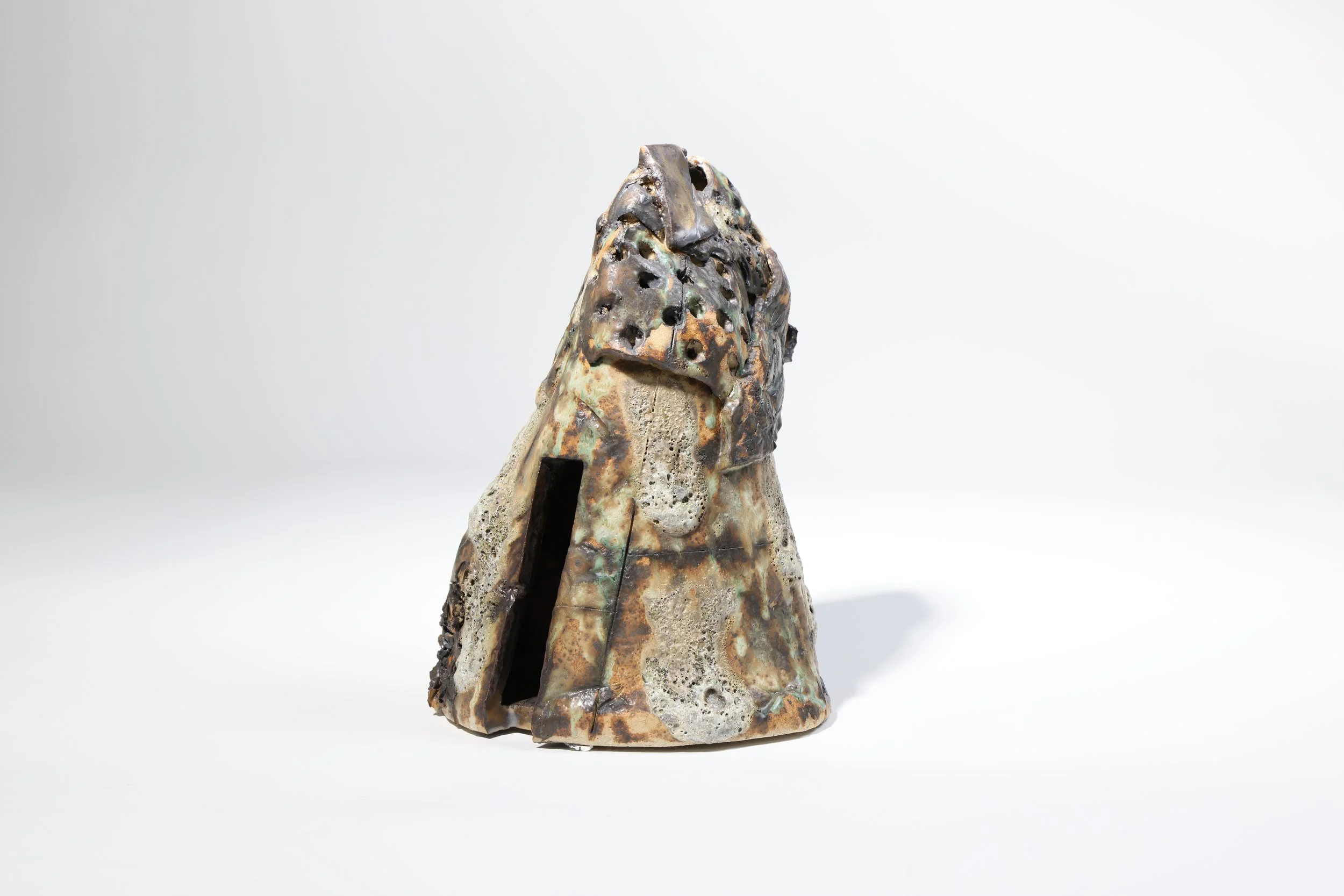
My Work- Vessel exploration
As stated above, this is the piece of work where I was exploring the meaning of a vessel by enclosing up the initial vessel structure and putting fragments of slabs over the top. I then went to re-open the side of the piece to expose the interior.
Extract two-
CERAMICS AND PAINTING: An Expanded Field of Inquiry-Veronika Horlik, Page 398 of The Ceramic Reader
The main area of interest for me within this extract was this idea of the Semiotic Square. “The square is a map of logical possibilities” Pg 399
This was developed by French Semioticians Greimas and Rastier in the 1960’s. It was created as a means of refining, yet expanding on an idea. The square is a visual representation of ideas and helps create possible relationships between each idea.
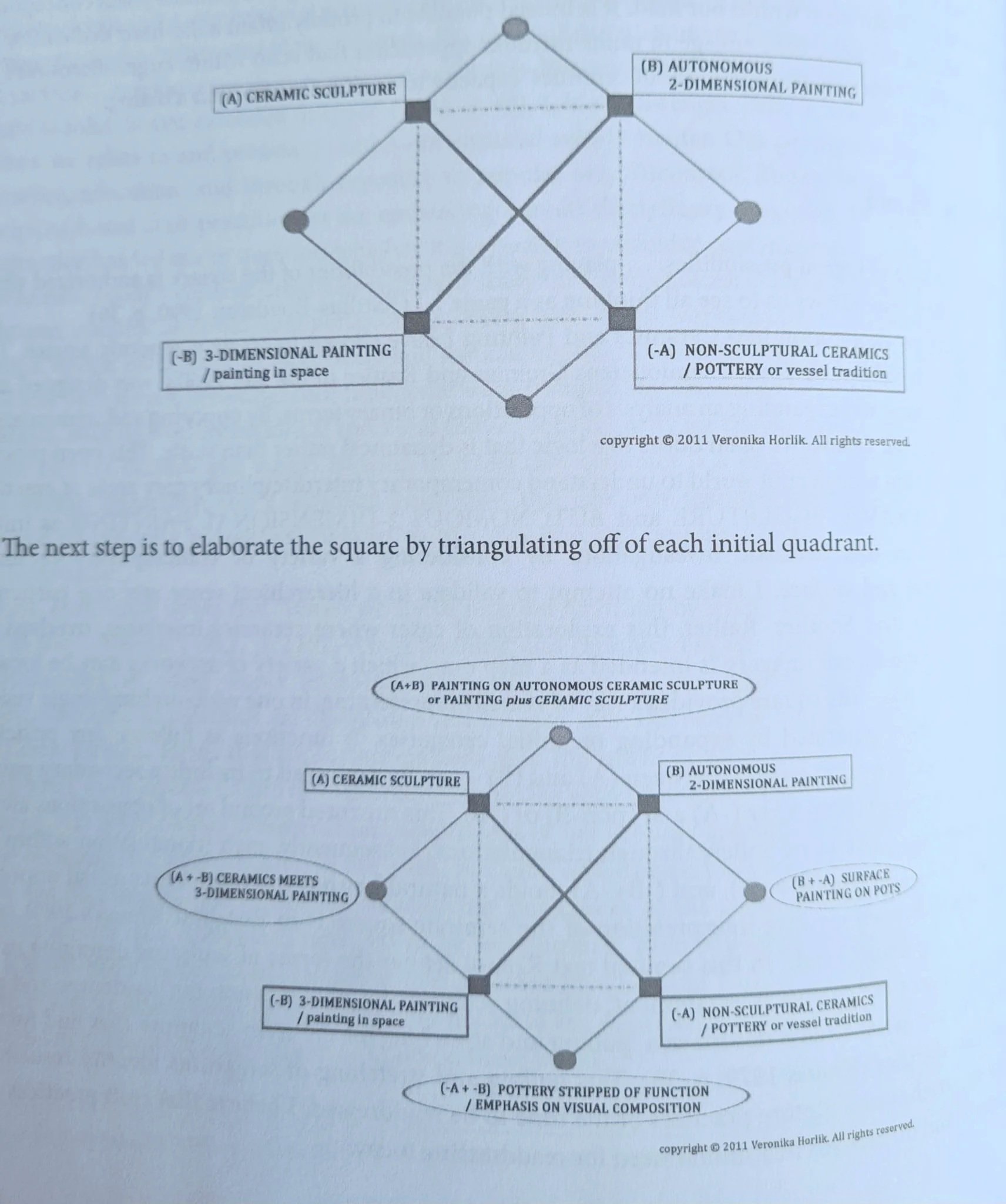
The Semiotic Square
This is the example in the book on page 400. They’ve picked four areas of interest on the first diagram and then on the second, it’s the paired them together to create four new ideas or tangents to explore.
In the extract, they go on to explore each category and potential artists that could fit in these areas.
For example, Craig Underhill is a key example for A+ -B (Ceramics Meets 3-Dimensional Painting)
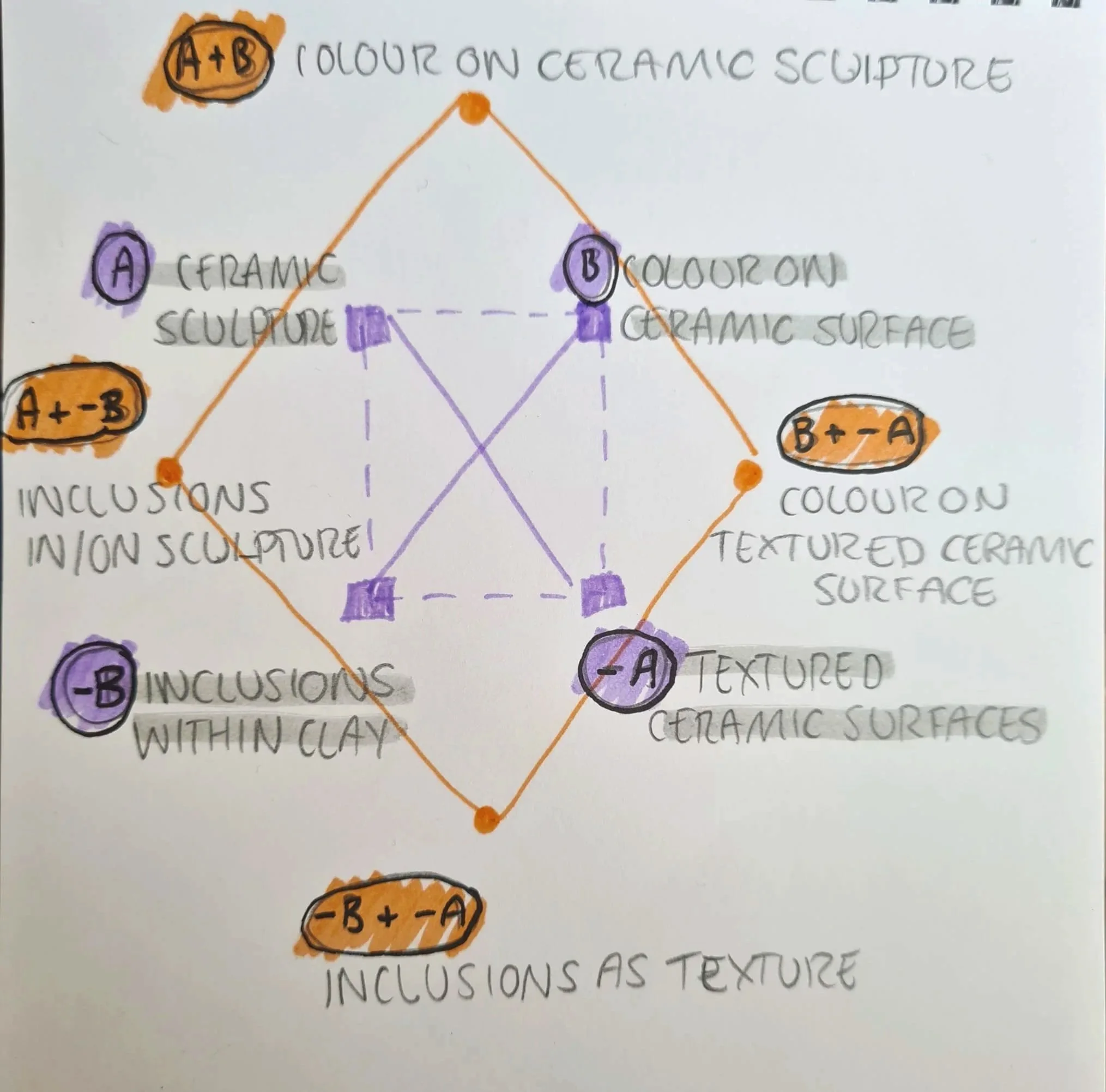
My own Semiotic Sqaures & Reflecting upon their use within my practice
I used some general themes within my work to generate some new relationships between them. Upon doing this exercise, I’ve established I’ve explored all of these basic themes within my work.
It would be interesting to do in the second year as my contextual research develops around my work as I could do the same exercise but for contextual research purposes.
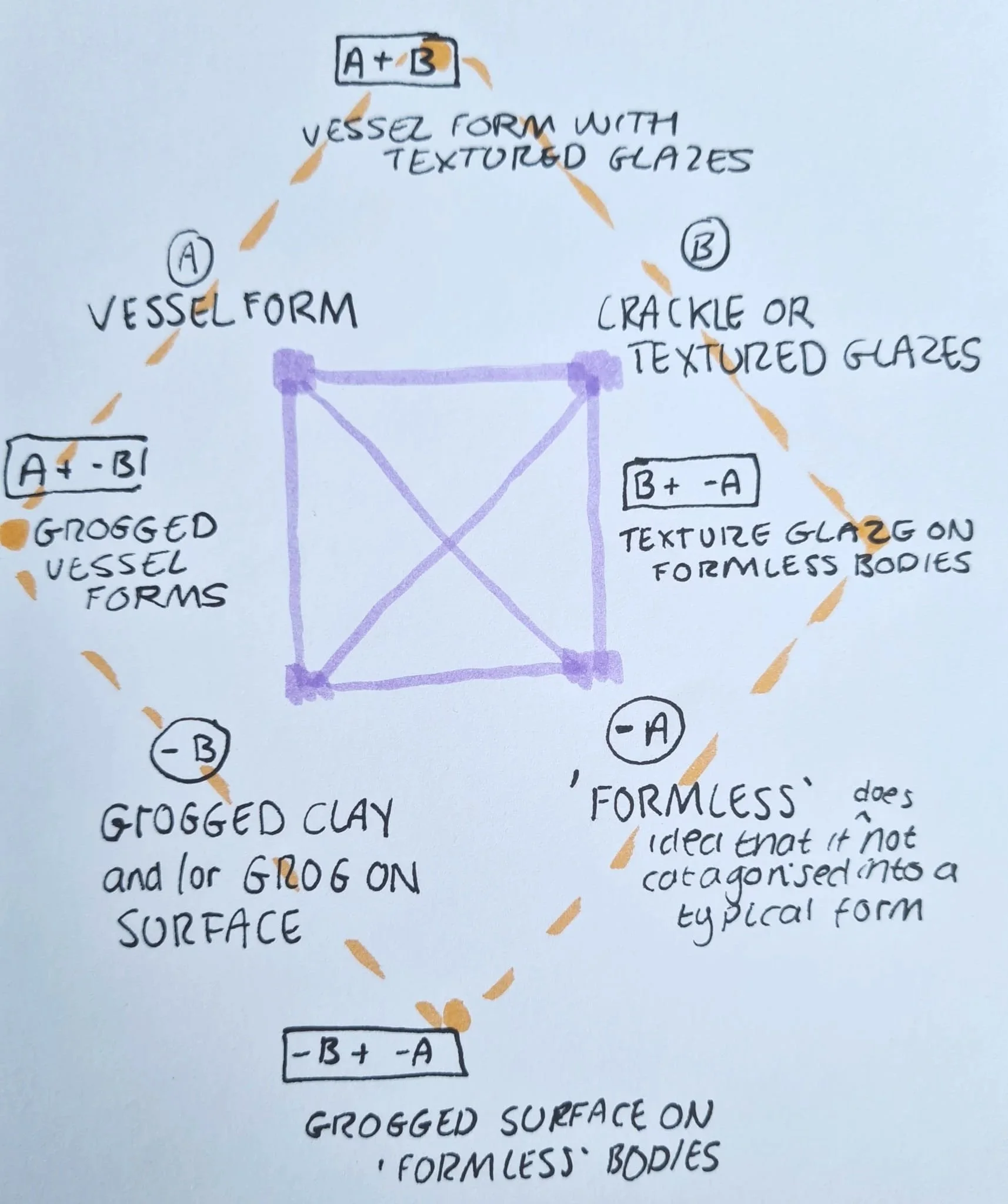
Another one I did with a variety of different themes within my work currently. The idea behind the ‘Formless’ is that I could create forms that don’t typically fit into a category as such. The sculpture category is so broad so it would be interesting to explore this idea of the formless or lack of structure- Allowing the clay to dictate the form due to multiple reasons, such as gravity, moisture levels, thickness of the slab.
This would of been a great exercise to do earlier on in the year as I had a small area of topics I was exploring and could have helped develop some ideas sooner. However, I’m still very much in the developing stage and I will re-visit the Semiotic Square throughout my time on the masters as it has proved to be a valuable exercise for developing the potential of my ceramic practice.