

‘Bonsai Fascination’ / Eddie Curtis
Article in the New Ceramics magazine by Eddie Curtis (March-April 2026 edition) - Pg 25
April-August 2026 Semester
The article is written by Eddie Curtis, who is also the creator of the pots shown.
It states there should be a conscious relationship between the container or vessel that respond to the tree being planted within the container. The potter should mimic the presence of the tree in the container, picking up on details, textures or forms of the tree. I found this article initially interesting due to the pots created to hold the Bonsai. They consist of crackle glazes, oxides and organic forms. Two images in the article are pots by Eddie Curtis, the image below is not from the article, but is a pot by Eddie Curtis.
The article also discusses the philosophy of The Five Agents Theory which categorises natural phenomena into 5 essential elements- Wood, Fire, Earth, Metal and Water. Over time, the Bonsai became on to represent these 5 elements as it contained a fragment of nature within a small container, which could then be used for worship or prayer. Curtis paired the philosophical importance of the Bonsai with ceramics, as ceramics also held it’s own ritualistic values of it’s own (Such as the use of a vessel object). His aim with the pots, was to tell a story that ‘visually conveys their struggle against the elements and their consequent adaptations and interactions with the landscape (…) creating a pot that best conveys the relationship between tree and landscape”.
Curtis goes on to explain how the Bonsai pot has “enabled me to further my exploration of textures that allude to the landscape”. His making methods are what the pot require. He slab builds or throws, whilst stretching and distorting slabs that have cracked under the flame of a blow torch. These techniques elude to the forces of nature. Furthermore, the stoneware forms are coated with a thick application of porcelain slip and aggressively dried to rupture and crack the surface. Curtis believes these suggest an aged landscape or rock geologies.
“My continuing quest is to bring together the discipline of Bonsai with the art of ceramics, to create naturalistic presentation that promotes a feeling of harmony, guided by principles that manifest the essence of wabi-sabi- two deeply important icons of creativity”.
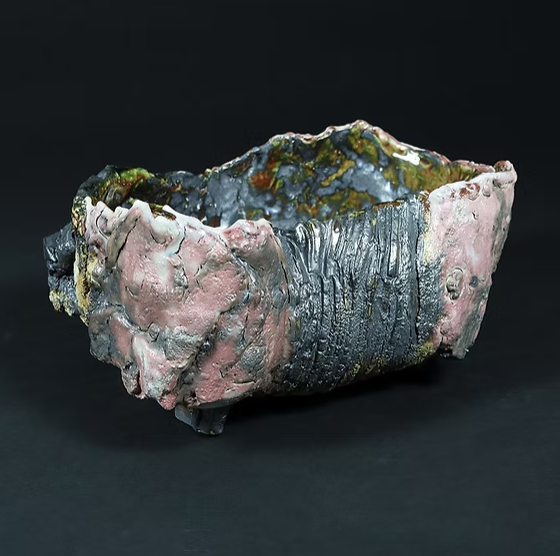
Pot by Eddie Curtis, similar to those shown in the article.
The cracked surface, filled with oxides, paired with the pinkish and gold glaze creates a visually and texturally vibrant piece. There is a want to touch the piece and feel the quality of the texture and marks.
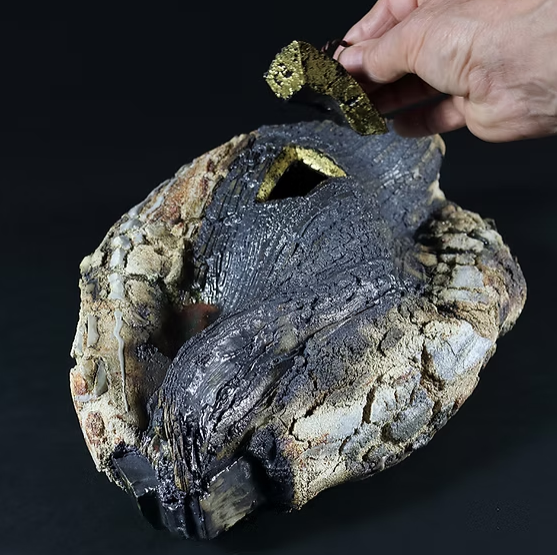
Pot by Eddie Curtis
You can see the cracked porcelain, thickly applied and how it’s ruptured under the heat. The clay has been stretched and pulled, put under stress. As stated- There is a harmony here also, a fine balance between chaos and organised matter.
Reflection
I find this article to be extremely helpful within my practice. I used the method of applying porcelain slip to a clay surface and stretching and ripping it out, whilst also using heat. Applying a thicker coating would have given a stronger visual effect. However, Curtis’ relationship between ceramics and nature is inspiring, the ability to mimic the forces of nature within his work is a challenge, yet his vessels demonstrate process effortlessly. I’m figuring out how to find that harmonic balance in my work, whilst also incorporating man-made inflictions, perhaps as a reflection on how man has impacted the natural environment. Finding that balance between the two, is the challenge I’m facing and trying to solve weekly in the studio.